
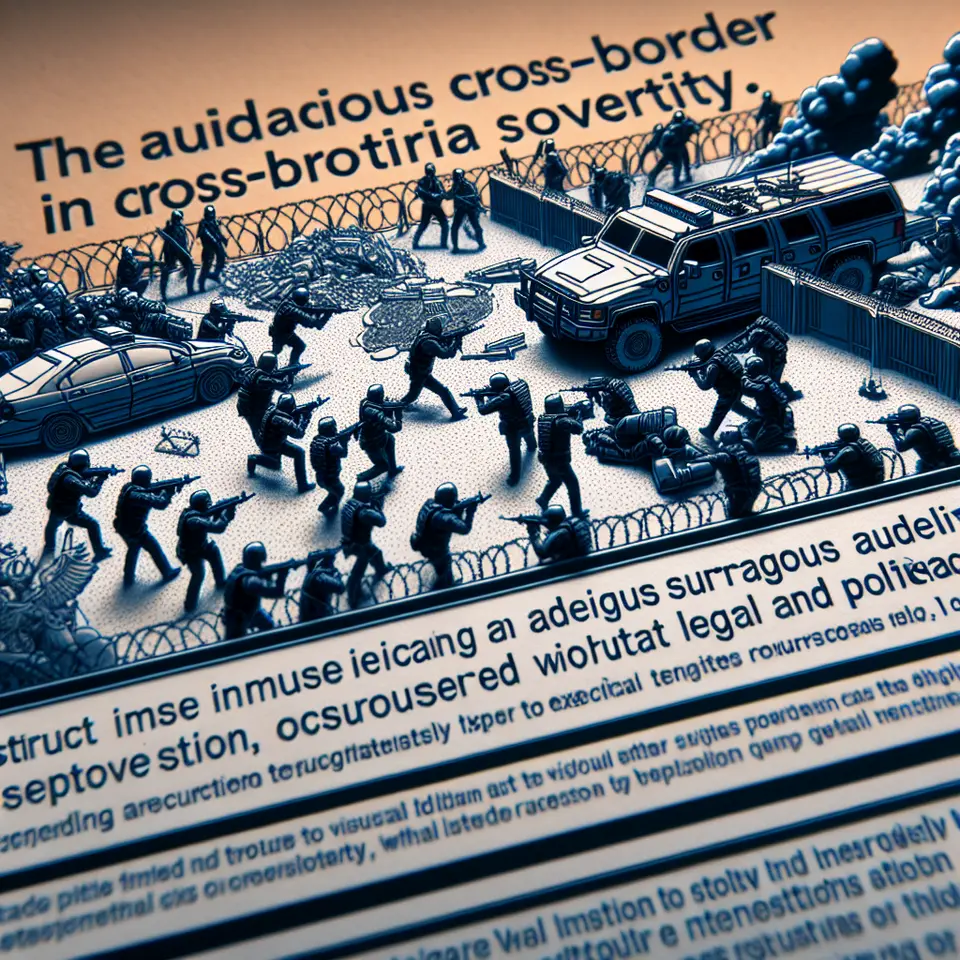
Was Trump\’s Venezuela Strike Legal? A Data-Driven Analysis
Estimated reading time: 5 minutes
Overview
In a data-driven turn, CNN reports that the White House initially suggested land strikes in Venezuela would require Congressional authorization, a stance echoed by Susie Wiles in November. Yet, two months later, the administration carried out a large-scale strike and captured the country\’s leader without notifying Congress. The move sparked a debate about the legal basis for cross-border, unilateral action and the tension between executive power and statutory oversight.
The public narrative shifted as President Trump described aims beyond arrest, signaling potential objectives around oil infrastructure and broader influence. Analysts note this ambiguity matters, because consistency in justification is a key marker of legitimacy in presidential actions abroad.
The Legal Arguments
Some allies described the operation as fulfilling a law-enforcement function, framed around protecting personnel during an arrest warrant. Others cautioned that arresting a foreign leader or controlling a sovereign state crosses a threshold that typically demands Congressional input. The conversation was complicated by signals from administration aides about potential reliance on executive authority, rather than a published legal memorandum from the Justice Department.
Across the spectrum, the debate centers on where authority ends and accountability begins, and how future presidents should structure cross-border actions to avoid legal ambiguity.
Reactions From Officials
- Sen. Mike Lee suggested Rubio described the operation as necessary to protect those carrying out the arrest, invoking the president\’s inherent powers in defense of personnel.
- Vice President JD Vance echoed that line, pointing to U.S. indictments and narcoterrorism concerns as justification.
- Sen. Marco Rubio framed the effort as supporting a law-enforcement function, contributing to a broader national-security narrative.
Historical Context and Comparisons
Analysts compare the Venezuela move to Panama in 1989, where the U.S. used a controversial approach to remove a leader. The 1980s era includes a memo by William P. Barr arguing that a president can employ inherent authority to abduct foreign targets, a memo that remains deeply debated for its international-law implications.
China and other nations criticized the strikes as a sovereign intrusion, underscoring how history, law, and diplomacy intersect when power is projected across borders.
Implications Going Forward
The episode illuminates ongoing tensions between swift executive action and the need for clear statutory oversight. Analysts warn of diplomatic spillovers and constitutional challenges, urging a robust framework to guide future cross-border operations. The legitimacy question, meanwhile, will influence future debates on U.S. foreign policy and accountability.
Conclusion
As this case evolves, the core issue remains: can a president act decisively abroad without a transparent, unified legal justification and congressional notification? The answer hinges on forthcoming legal clarifications, the political environment, and the resilience of constitutional checks in foreign affairs.
Source: https://www.cnn.com/2026/01/03/politics/legal-authority-trump-venezuela
Leave a Reply