
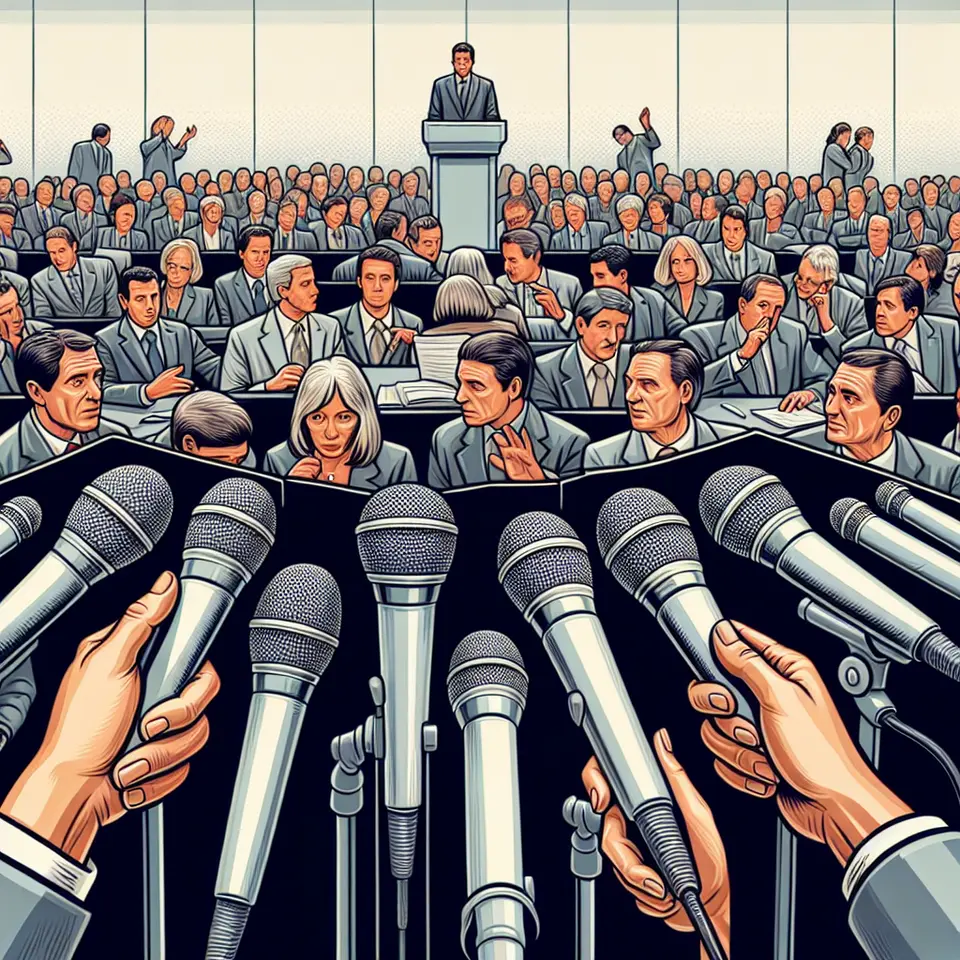
GOP Critics Quietly Critique Trump
Estimated reading time: 4 min
Key takeaways
- Direct opposition remains the third rail in GOP politics, as many lawmakers avoid critiquing Trump head-on.
- Bad advice is the common refrain used to explain Trump’s policy misgivings.
- Examples span foreign and domestic policy, highlighting nuanced dissent within party lines.
- Attention to foreign policy reveals cracks in support related to Greenland, Iran, and Venezuela actions.
Table of contents
Overview
Republicans have found a way to disagree with President Donald Trump’s ideas without actually disagreeing with him. There has been a recent uptick of Republicans using the rationale that it’s not Trump making unwise decisions — it’s that he’s received “bad advice” or is not actually serious about some of his most high-profile policy proposals.
Given the solid grip he’s had on the party for the past decade, direct criticism of Trump is a third rail of modern Republican politics, which has been on full display during his second term. Over the past year, Trump has proposed initiatives that have seemingly been at odds with conservatives and his own MAGA base, leaving them to blame external forces for him steering off course.
Why Republicans Avoid Direct Criticism
Sen. Thom Tillis, R-N.C., has said Trump has gotten “bad advice” on issues ranging from a proposed U.S. takeover of Greenland; repeated attacks on Federal Reserve Chair Jerome Powell; criticisms of Sen. Chuck Grassley, R-Iowa, on approving judicial nominees; and the pardon of Jan. 6 rioters. “The president has been given bad advice, and whoever gave him bad advice should probably not be in that role,” Tillis told NBC News last week of Trump’s Greenland pronouncements.
Earlier this year, Sen. Rand Paul, R-Ky., directly blamed Trump trade adviser Peter Navarro for the plan to implement across-the-board tariffs. “Yeah, it’s not the president,” Paul said. “I mean, Navarro is a protectionist. He thinks that tariffs are good and that trade is bad, and so he’s wrong on the issues.”
Over the summer, Sen. Bernie Moreno, R-Ohio, told NBC News that he thought the president shouldn’t have named Powell as Fed chair in 2018. But, he added, it wasn’t Trump’s fault. “Sometimes you make bad decisions and are given bad advice,” Moreno said. “And President Trump was obviously given bad advice by somebody he trusted.”
And as Trump has recently embraced some economic policy proposals that would usually come from progressives, Senate Majority Leader John Thune, R-S.D., said he thinks Trump is being steered in the wrong direction. “And so, you know, he may be getting advice on some of those issues, like, for example, the 10% cap on credit cards,” Thune said yesterday. “Don’t know where that came from. I don’t know. I don’t know the answer.”
Key Examples
The GOP’s approach includes both caveats and attributions to outside advisors, rather than a direct rebuke of the president. Rand Paul’s critique centers on Navarro’s tariffs stance, while Tillis emphasizes consequences for those who give bad counsel. Moreno’s careful language stresses the blame on advisers, not the president, and Thune signals uncertainty about where proposals originate.
These cues reflect a broader strategy: maintain party unity while signaling policy disagreements that could influence future decisions without fracturing the Trump-aligned base.
Foreign-policy cracks
A congressional delegation is in Denmark amid Trump’s Greenland ambitions. The group includes two GOP senators, Lisa Murkowski of Alaska and Thom Tillis. Murkowski told NBC News that “support in Congress to acquire Greenland in any way is not there.”
A few Republicans have also pushed back on the prospect of U.S. military action in Iran. Rep. Nick LaLota, R-N.Y., told reporters, “I don’t think that U.S. military involvement is appropriate at this time.”
Trump also touted two Republican senators, Josh Hawley, R-Mo., and Todd Young, R-Ind., who opposed a Venezuela war-powers resolution. “They opposed the resolution after initially voting to advance it,” allowing Vice President JD Vance to cast the tiebreaking vote. Kaine and Rand Paul will join a Meet the Press segment as part of NBC’s “Finding Common Ground” series.
For more on these dynamics, read the full report in NBC News.
Implications
While Trump remains the central figure, the emergence of measured dissent hints at potential clashes between Congress and the White House over foreign policy and domestic policy strategy, particularly as Republicans balance loyalty with accountability.
Source: https://www.nbcnews.com/politics/politics-news/republicans-criticize-trump-politics-desk-rcna254478
Leave a Reply